

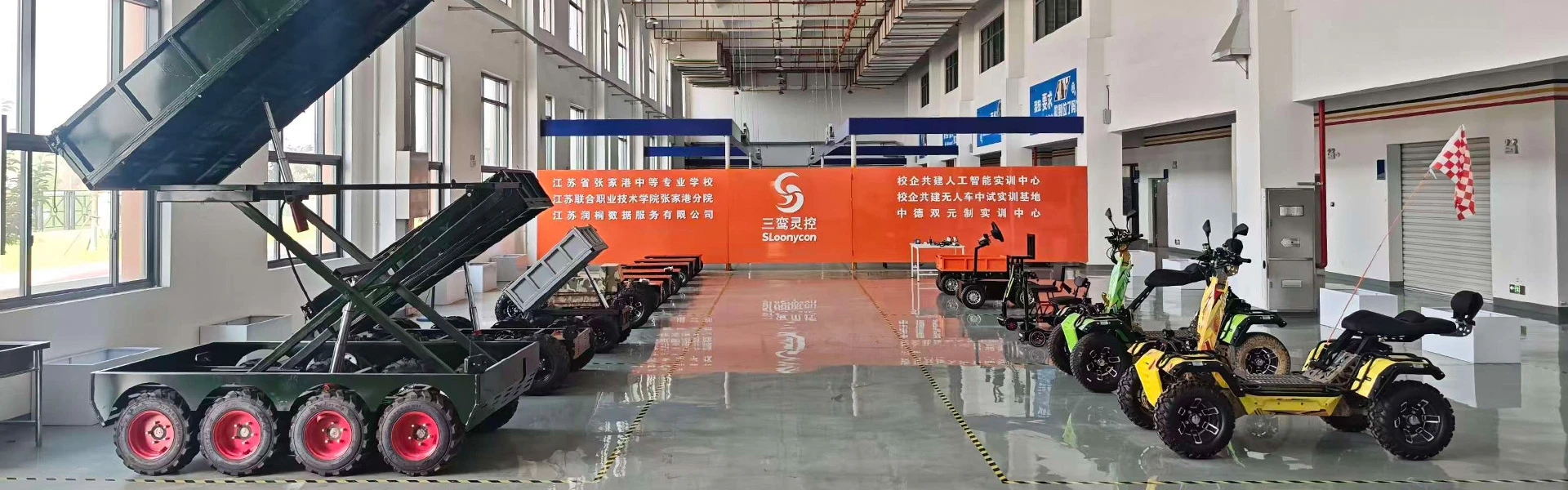

Tracked Robot Chassis
Your Professional Tracked Robot Chassis Supplier
SLoonlycon is a technology brand under Jiangsu Runtong Data Service Co., Ltd., a national high-tech enterprise founded in 2014 in Jiangsu, China. We specialize in intelligent mobility and autonomous system solutions, including unmanned transport vehicles, intelligent following vehicles, sightseeing vehicles, camping vehicles, luggage, and modular intelligent chassis. Our products are widely used in smart logistics, intelligent manufacturing, cultural tourism, and leisure applications, supporting reliable, cost-effective, and customizable intelligent operations.
Advanced Autonomous Technology
We focus on unmanned driving, intelligent following, obstacle avoidance, and remote control solutions for closed scenarios. Our systems are developed in-house and designed for stable, practical use in real industrial and commercial environments.
Strong Engineering Team
Around 60% of our staff are engineers in AI, automation, and mechanical design, with an average of 8 years of experience. This ensures reliable product design, system integration, and continuous technical improvement.
Reliable After-Sales Support
All vehicles and key components are covered by a 12-month warranty. We provide installation guidance, remote technical support, and original spare parts supply to ensure stable operation and long-term customer confidence.


Parameter
|
Dimensions: |
L: 2400mm W: 1350mm H: 550mm |
|
Load Capacity: |
1500kg |
|
Total Vehicle Weight: |
700kg |
|
Top Speed: |
7km/h |
|
Runtime: |
Depends on the battery and usage |
|
Battery Specification: |
Optional |
|
Intelligent Obstacle Avoidance: |
Radar obstacle avoidance or ultrasonic obstacle avoidance |
|
Tracking Distance: |
1.5m-10m |
|
Fuel: |
Electro |
Improved Stability
One of the primary advantages of a tracked chassis is its superior stability on uneven surfaces. Unlike wheeled robots, which are more susceptible to tipping over or losing traction on rocky or sloped terrain, tracked robots maintain a consistent balance due to the even distribution of weight across the tracks.
Enhanced Traction on Soft and Loose Surfaces
Tracked robots excel in environments where wheels would struggle. In soft terrain such as sand, snow, or mud, the continuous tracks provide far better traction. Unlike wheels, which sink into loose ground, the wide surface area of tracks distributes the robot’s weight more effectively, preventing it from getting stuck.
Greater Load-Bearing Capacity
A tracked robot chassis is inherently designed to handle heavier payloads compared to a wheeled robot of the same size. The design of the tracks allows for a larger surface area in contact with the ground, thereby reducing ground pressure and enabling the robot to carry additional equipment without sacrificing mobility.
Better Maneuverability in Challenging Conditions
Tracks allow a robot to maneuver in ways that wheeled robots simply cannot. With the ability to rotate in place, tracked robots can change direction without needing to move forward or backward, a feature that’s incredibly useful in tight spaces.
Durability in Harsh Environments
Tracked robot chassis are built to withstand tough, unpredictable environments. Whether it's operating in extreme temperatures, wet conditions, or rugged terrain, tracked robots are built to endure the harshest conditions.
Applications of Tracked Robot Chassis
Robotics Education
In STEM (Science, Technology, Engineering, and Mathematics) education, tracked robot chassis serve as powerful learning tools that bridge theoretical knowledge with practical implementation. These platforms allow students to engage in hands-on engineering, from mechanical assembly to coding autonomous navigation algorithms.
Research and Development
Tracked chassis are widely adopted in R&D environments as modular testbeds for developing next-generation robotic technologies. Their durability and adaptability make them ideal for prototyping and field testing under real-world conditions.
Agriculture
In modern precision farming, tracked robots are revolutionizing how crops are planted, monitored, and maintained. Their low ground pressure and all-terrain mobility allow them to operate in soft or wet soils without causing compaction—preserving soil health and crop yield.
Construction and Mining
Harsh, unpredictable environments in construction and mining demand robust robotic solutions. Tracked chassis excel in these sectors due to their high load capacity, resistance to debris, and ability to navigate rubble, mud, and steep inclines.
Healthcare
Tracked robot chassis are increasingly being adapted for medical and caregiving applications, particularly in settings requiring reliable indoor navigation and payload delivery. While less common than wheeled counterparts, tracked versions offer advantages in environments with thresholds, carpets, or slight elevation changes.
Construction Materials for Tracked Robot Chassis
|
Material |
Key Properties |
|
Aluminum |
Lightweight, corrosion-resistant, easy to machine, good strength-to-weight ratio. |
|
Carbon Steel |
High strength, durable, cost-effective, but heavier and prone to rust if uncoated. |
|
Stainless Steel |
Excellent corrosion resistance, high strength, hygienic surface, more expensive. |
|
PVC/Plastic Composites |
Very lightweight, low cost, electrically insulating, but less durable under stress. |
|
Carbon Fiber Reinforced Polymer (CFRP) |
Extremely lightweight, high strength, excellent fatigue resistance, but costly. |

Lithium-Ion (Li-ion): High energy density, lightweight, long cycle life, and low self-discharge. Ideal for extended missions and portable robots. Requires protection circuits to prevent overcharging.
Lithium-Polymer (LiPo): Similar to Li-ion but more flexible in shape, allowing custom battery packs. Slightly less stable and requires careful handling and charging.
Lead-Acid: Inexpensive, reliable, and tolerant to overcharging. Heavier and bulkier, best suited for stationary or slow-moving robots where weight is less critical.
NiMH (Nickel-Metal Hydride): Environmentally friendly, safe, and moderate performance. Less common today due to lower energy density compared to lithium options.
Customizable Options
Size and Shape
Adjusting width, length, or height to fit through narrow passages or improve stability.
Material Selection
Upgrading to stainless steel or adding protective coatings for harsh environments.
Track Type
Swapping standard rubber tracks for aggressive treads, metal-reinforced belts, or snow/mud-specific designs.
Mounting Interfaces
Adding custom brackets, rails, or ports for sensors, arms, grippers, or communication modules.
Integrated Electronics
Pre-wiring for motor drivers, power distribution, or onboard computers.
Autonomous Features
Built-in support for LiDAR, GPS, IMU, or vision systems for autonomous navigation.
Packaging and Shipping
|
Packaging |
Generally, we pack our goods in paper package and Iron pallet. We can pack the goods in your branded boxes after getting your authorization letters. |
|
Shipping |
Shipping by sea, by air, by express are acceptable. According to your requirements. |
Our Factory
Our Certificates
In 2017: Obtained the Value-Added Telecommunications Business Operation License (ICP) issued by the People's Republic of China.
In 2018: Secured the project of "Capacity Improvement for Key Scientific and Technological Service Institutions in the Industry-University-Research Collaborative Innovation Base of Jiangsu Remanufacturing and Intelligent Manufacturing Industry".
In 2020: Was recognized as a Key Platform of Suzhou Industrial Internet.
In 2021: Was awarded the title of Jiangsu Manufacturing Demonstration Platform;
In 2023: Obtained the CS Information System Construction and Service Capability Certificate and the Information Technology Service Standards (ITSS) Level 4 Compliance Certificate in the same year.
In 2024: Received the Suzhou Information Technology Innovation Product Certificate.


