How accurate are the positioning systems of autonomous mobile robots?
Hey there! As a supplier of autonomous mobile robots, I've been diving deep into the world of their positioning systems. It's a fascinating topic, and one that can have a huge impact on the performance and reliability of these robots. So, let's chat about how accurate their positioning systems really are.
First off, what exactly is a positioning system in an autonomous mobile robot? Well, it's the technology that allows the robot to figure out where it is in its environment. This is crucial because without accurate positioning, a robot can't navigate effectively, perform its tasks, or interact safely with its surroundings. The most common types of positioning systems used in autonomous mobile robots include GPS (Global Positioning System), inertial navigation systems (INS), lidar (light detection and ranging), and vision - based systems.
GPS is probably the most well - known positioning technology. It works by using a network of satellites to determine the robot's location on the Earth's surface. But here's the thing: GPS isn't always super accurate when it comes to autonomous mobile robots. Outdoors, it can have an accuracy range of a few meters in open areas. However, in urban canyons, areas with lots of tall buildings, or under dense foliage, the GPS signal can get blocked or reflected, leading to significant errors. For a robot that needs to move precisely through a factory floor or a narrow corridor, a few meters of error is just too much.
Inertial navigation systems, on the other hand, rely on accelerometers and gyroscopes to measure the robot's acceleration and rotation. They're great for short - term, precise movements. The robot starts from a known position and then uses the INS data to calculate its new position over time. But the problem with INS is that errors accumulate over time. If the robot is operating for a long period or making a lot of movements, these accumulated errors can make the positioning system quite inaccurate.
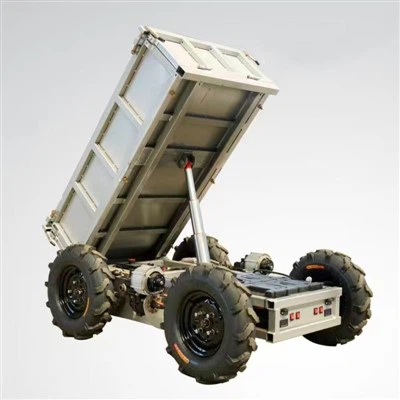
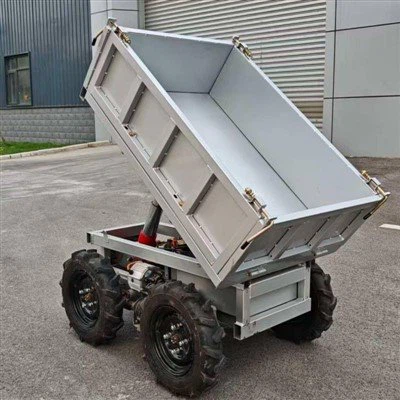
Lidar is becoming increasingly popular in autonomous mobile robots. It works by emitting laser beams in all directions and measuring the time it takes for the light to bounce back from objects in the environment. This creates a 3D map of the surroundings, which the robot can use to determine its position. Lidar can provide very high - accuracy positioning, often within a few centimeters. It's especially useful in structured environments like warehouses or factories, where there are plenty of static objects to detect. For example, our Smart Unmanned Feeding Vehicle uses lidar technology to accurately navigate through a farm environment, delivering feed to different areas with precision.
Vision - based systems use cameras to capture images of the environment. The robot then analyzes these images to identify landmarks and features, which it can use to determine its position. Vision - based systems can be very effective, especially in environments with distinct visual features. However, they can be affected by lighting conditions. Poor lighting, glare, or shadows can make it difficult for the system to identify features accurately, leading to positioning errors.
Our company has been working hard to improve the accuracy of our robots' positioning systems. We often use a combination of different technologies to overcome the limitations of each individual system. For instance, we'll use GPS for general outdoor positioning, but then rely on lidar and vision - based systems for more precise, local navigation.


We've also invested a lot in machine learning algorithms. These algorithms can analyze the sensor data from multiple sources and make more accurate predictions about the robot's position. They can adapt to changes in the environment, learn from past experiences, and correct for errors in the positioning data.
Let's take a look at some of our products and how their positioning systems perform. The Robotic Street Sweeper is designed to clean streets efficiently. It uses a combination of lidar and GPS to navigate. The lidar helps it avoid obstacles and stay on the correct path, while the GPS gives it a general sense of its location in the city. In tests, we've found that this combination allows the robot to operate with an accuracy of within about 10 centimeters on average, which is more than enough to perform its sweeping tasks effectively.
Another example is our Autonomous Inspection Robot. This robot is used to inspect industrial facilities. It relies heavily on vision - based systems and lidar to navigate through complex machinery and check for any signs of damage or malfunction. The vision - based system can identify specific components and markings, while the lidar helps with accurate positioning in the 3D space. Thanks to our advanced algorithms and sensor fusion techniques, this robot can position itself with an accuracy of a few millimeters in critical inspection areas.
But we're not stopping there. The field of autonomous mobile robots is constantly evolving, and so are the positioning technologies. We're always looking for ways to make our robots even more accurate. One area of research is the use of ultra - wideband (UWB) technology. UWB can provide very precise distance measurements, and when integrated into our existing positioning systems, it could potentially improve the accuracy even further.
So, to answer the question of how accurate the positioning systems of autonomous mobile robots are, it really depends. In general, with the right combination of technologies and advanced algorithms, we can achieve accuracies ranging from a few millimeters to a few centimeters in most practical applications. However, there's always room for improvement, and we're committed to pushing the boundaries of what's possible.
If you're in the market for an autonomous mobile robot and are concerned about positioning accuracy, we'd love to talk to you. Our team of experts can help you understand which of our products is the best fit for your specific needs and how our positioning systems can meet or exceed your expectations. Whether you're running a large - scale industrial facility, a farm, or a municipality looking for a street - cleaning solution, we've got the right robot for you. Reach out to us for a detailed discussion and let's see how we can work together to make your operations more efficient and productive with our high - accuracy autonomous mobile robots.
References
- Thrun, S., Burgard, W., & Fox, D. (2005). Probabilistic Robotics. MIT Press.
- Siegwart, R., Nourbakhsh, I. R., & Scaramuzza, D. (2011). Introduction to Autonomous Mobile Robots. MIT Press.