


If you follow the low-speed autonomous vehicle and mobile robot industry, you must have heard of drive-by-wire systems. Today we'll break down this key technology in plain terms, covering what it is, its main components, and why it outperforms traditional mechanical setups.
First off, what exactly is a drive-by-wire system? Simply put, a drive-by-wire (DBW) system replaces rigid mechanical linkages like connecting rods, gears and cables with electronic signals, sensors and controllers. Instead of relying on physical force to control a vehicle, commands are transmitted digitally. This tech is widely adopted on modern intelligent chassis, unmanned transport robots, warehouse AGVs and park service vehicles, and it has become a fundamental part of unmanned mobile equipment.
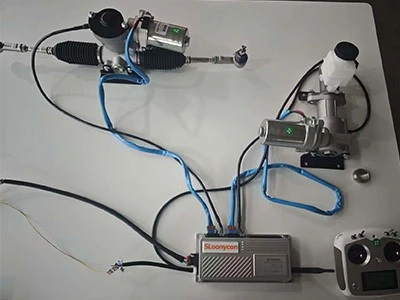
Core Components of a Standard Drive-by-Wire System
A complete drive-by-wire mobile system mainly consists of three core modules, plus supporting control and communication units:
Drive-by-Wire Drive System It controls the vehicle's forward, reverse and speed adjustment via electric signals. Paired with brushless DC motors, it delivers smooth and stable power output, and works perfectly for low-speed operation scenarios such as material handling and on-site patrol.
Drive-by-Wire Steering System Based on classic Ackerman steering structure, this module executes steering commands electronically. It features high steering precision and flexible turning performance, ideal for moving and turning in narrow factory aisles and compact work areas.
Drive-by-Wire Braking System Most industrial-grade solutions use a dual-brake combination: electro-hydraulic braking and motor braking. It ensures reliable and quick braking response, and supports power-off self-locking parking to keep vehicles stationary safely when powered down.
Besides the three major execution modules, a dedicated chassis control unit and standard CAN communication interface are also equipped. They manage all electronic commands, support remote debugging and system upgrades, and enable seamless connection with upper-layer navigation, obstacle avoidance and dispatching systems.
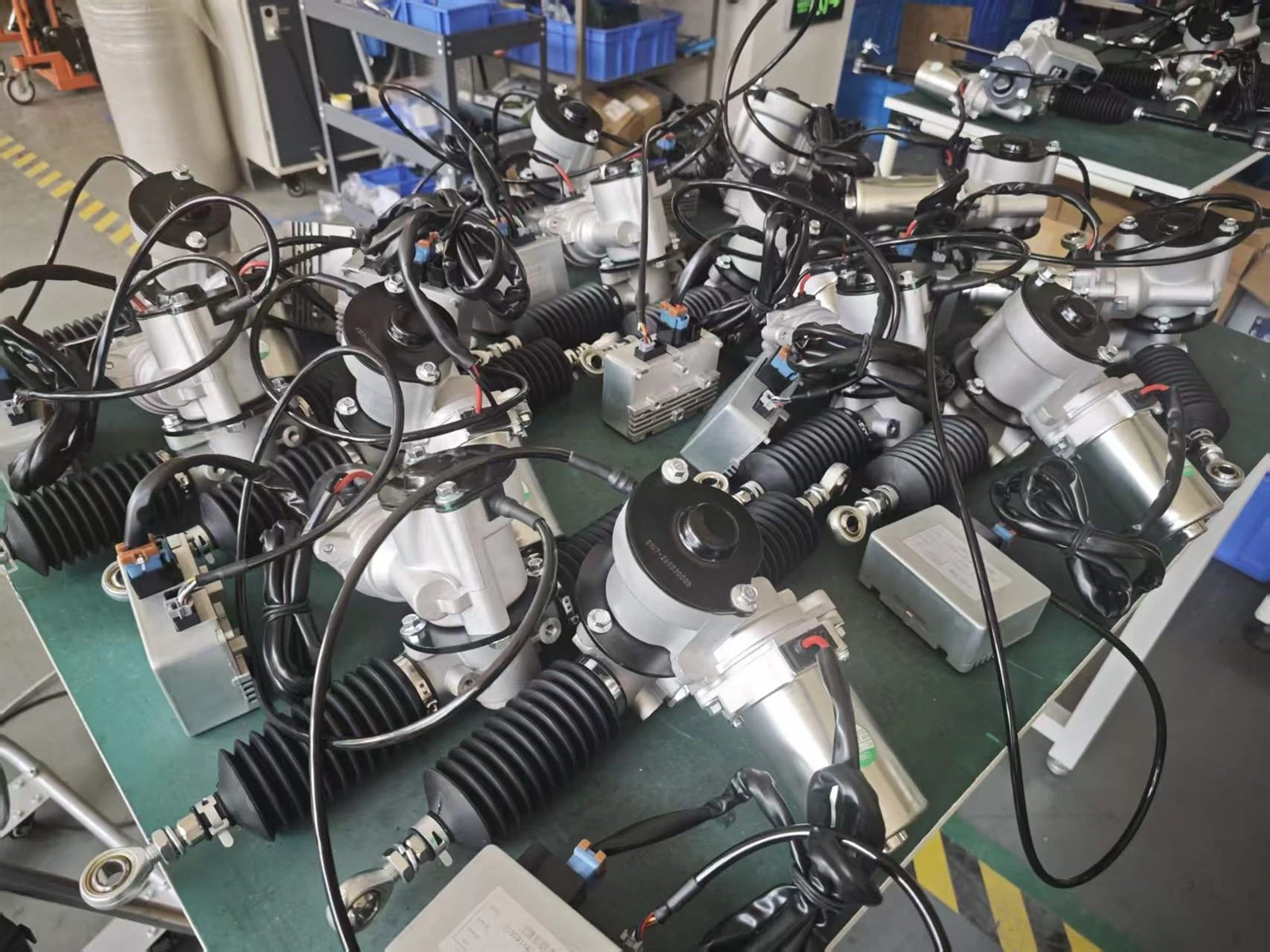
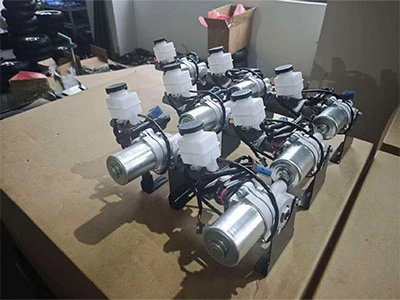
Key Advantages: Drive-by-Wire vs. Traditional Mechanical Systems
After years of on-site application, we've summed up the obvious strengths of drive-by-wire systems compared with traditional mechanical transmission:
Simpler integration & lower development barriers Traditional mechanical structures require complicated assembly, calibration and mechanical matching. Drive-by-wire systems use standard CAN communication ports, which are compatible with most mainstream controllers. Clients can finish secondary development and equipment modification in a much shorter time, no need to tackle complex mechanical adjustments.
Higher precision & better stability Electronic signal transmission has far higher accuracy than mechanical linkage. Every action of driving, steering and braking is executed precisely. Combined with industrial-grade protection design, the whole system runs steadily in different temperatures and humidity environments, fully meeting long-duration industrial operation demands.
Great flexibility for customization Thanks to modular design, drive-by-wire chassis can be easily fitted with different upper devices. Whether you need a material transport vehicle, cleaning robot, patrol car or testing platform, we can complete functional matching quickly. It greatly improves the versatility of the whole vehicle.
Enhanced safety & reliability Dual-brake design and power-off self-locking function bring double safety guarantees. Meanwhile, fewer mechanical wearing parts mean lower failure rates and easier daily maintenance, cutting long-term operating costs effectively.
Easy to realize full unmanned operation Digital signal transmission is the premise of autonomous driving. Drive-by-wire systems can be seamlessly connected with navigation and obstacle avoidance systems, helping vehicles achieve fully autonomous travel, which is nearly impossible to realize efficiently on pure mechanical vehicles.
To sum up, drive-by-wire technology is not just a technical upgrade, but a necessary choice for the intelligent transformation of mobile equipment. As unmanned applications keep expanding across logistics, manufacturing and enclosed parks, drive-by-wire chassis and related systems will continue to be the mainstream solution for the industry.


